
How to get unstuck and enjoy your work despite high pressure & workload?
It has been 1,5 years since Dane successfully got his PhD. Seen on the surface, he appears to be doing great. He has several short term teaching positions and is even creating some consulting business directly from his PhD research. This is quite remarkable, because direct valorization of research is quite rare for a PhD in the Humanities. His former supervisor is confident that his career will turn out allright. The university is happy because Dane’s official status is ‘employed’.
But Dane is not happy with his situation at all. The short term contracts make him restless. The uncertainty of his employment cause sickening amounts of stress: he has been absent from work several times already and this goes directly against his work-ethic. It does not help that the social worker he talked to does not understand his situation at all. Yet he does not blame her: academia has its own rules and quirks.
Trapped in the ratrace?
Dane is a great teacher and he loves lecturing and guiding students to a more mature understanding of the topic. His motivation is with higher education, collaboration and creative input. “I am just not motivated enough to undertake the publish-or-perish battle in research to have any change on a permanent position,” he sighs.
“I have been going round and round in my head. It must be that I lack initiative and the hard working, industrious drive to make it at the university,” he concludes. “Now I don’t even know whether I want to continue in academia anymore. But I don’t have a clue about my chances and options outside.”
“You, lack initative?” I ask, eyebrows raised. “You seek coaching because a few or your projects are almost finished and you want to be ready for the next step. You have single handedly turned your PhD into a profitable consulting instrument. And secured contracts to develop and teach advanced courses on your topic. That does not exactly sound passive to me!”
But I get it, of course. It is not easy to find a way out of the academic ratrace and still feel successful. Dane wants intellectual exchange in his work but not the pressure to publish in peer reviewed, A-ranked journals. He is afraid he will end up in a job that does not challenge him. He is afraid to be labelled lazy. And he is afraid that his PhD investment does not pay off. His fear is so strong that he is extremely tough and demanding for himself. His body radiates tension as we talk.
“Imagine,” I suggest, “a very good friend looking at you now, hearing what you are telling me. He understands you deeply and doesn’t judge you. He just loves his friend and wants what is best for him, wants him to be happy. What would he advice you?”
Dane sits speachless for a few minutes. Tears start rolling down his cheeks. He does not explain — he does not have to. The harsh grip of stress and the pressure to perform ever better, ever more eases slowly. A more compassionate, more realistic self-assessment shines through the cracks.
Find the music
Next time we talk, Dane is elated at two highlight events of very different kind. He has become a father and he has given a stellar presentation about his research that could lead to several consulting assignments.
We investigate what makes the difference for him since the situation at our previous meeting. “Aha, I always thought I was working energetically, while I was actually just working under pressure of the next deadline,” he realizes. “I confused the stress of working hard with high energy! I always scold myself for procrastinating on important stuff until the last moment. Then, I have to deliver under high pressure.
But now, with my newborn, I have given myself permission to let go of my perfect preparations and delivery. It is like playing the French horn: you have to anticipate what is coming while staying in touch with what is happening now in the music. You have to let your breath flow in a relaxed kind of power. If you force it, you harm the music.”
Now the trick is to recognize the turning point: where does power turn into force? When does high energy turn into too much pressure? Which stressors drain you most? Your energy levels literally determine your outlook on your situation and your thoughts about your possibilities. And the ingredients of your best and most sustainable career options will be the exact activities, environments, people and values that give you energy. Identify them and you have your personal road signs on your career path.
Sit on the wave
As he proceeds with his personal energy investigation, Dane’s restlessness recedes. The stressful worry about his instable employment situation dissolves. He no longer judges himself as reacting passively, avoiding work, lazy and distracted. He is pleased to realize that he has actually created a fine balance of teaching, consulting and research for himself. The inner friend that he imagined before agrees that the mix suits him very well.
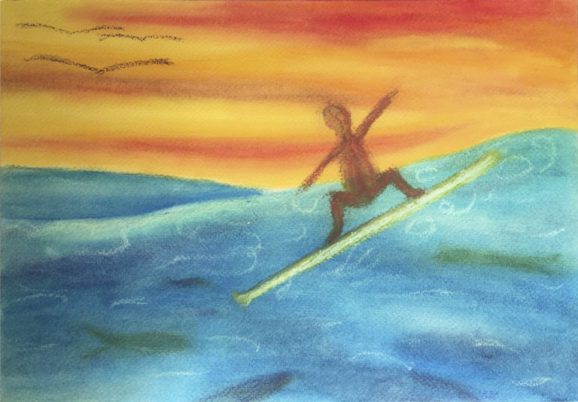
“I have learned to sit on the wave,” he describes his new feeling, “instead of paddling madly against it. I used to exhaust myself chasing after an elusive goal, frustrated when I did not seem to make any progress. Now I am aware of the speed of the wave. I trust how it carries me and I use its power to work effectively in the moment while I stay relaxed and in charge.”
The image that his words evoke differs crucially from the popular adage “go with the flow”, which has a directionless ring to it. Dane sits on his wave, confident that it brings him exactly where he wants to go and that it will provide him with energy, the momentum that he needs to realize his dream.
P.S. See that drawing? I keep a personal diary of my nighttime dreams. Sometimes I write about them, sometimes I draw them. The funny thing is, Dane’s analogy is exactly as a stunningly detailed and realistic dream I once had about the same feeling. (Nevermind my drawing skills. Oh, and can you tell that I have never surfed an actual wave in my life? 😉 )
To me this drawing reflects the feeling of joy and freedom when you surf a wave. Your hair flying in the salty wind and the sun on your skin. There is the thrill of being on top combined with the risk of falling into the unknown below the surface, with its scary fish and everything. My dream lesson was that it takes practice to “sit on the wave”: you will take a plunge repeatedly, paddling and gasping, but it is worth it. Because you will get back on top, hair in the wind, face in the sun. Again, and again, and again. I am not saying practice makes perfect, but I am getting better at it. And so you will, too.
P.P.S. Do you want to know how you can access the resilience that helps you face the uncertainties and unpredictability of life-after-your-PhD? Contact me here to break through the vicious circle of your thoughts and get a clear view on how to act.

It’s not easy to find a way out of the academic ratrace and still feel successful. Read *this month’s new… https://t.co/RUY7kTu2aj