Rethinking the “Profkip”: From Counting Heads to Professionalizing Supervision

Yesterday, I attended the symposium organized by the KNAW and the Jonge Akademie on the topic of “Profkippen”—professors supervising an excessive number of PhD candidates. The background document highlights that a dramatic rise in PhD FTEs since 2019 has outpaced the growth of supervisory capacity, creating a “hourglass” structure that compromises quality and well-being.

While it is a great step forward that this topic is being addressed, the discussion itself felt somewhat fragmented. There were many “proefballonnetjes” (trial balloons) and diverse opinions (the panel consisted of a mixture of representatives of PhD, postdoc, assistant and full professor perspectives), yet the conversation was all over the place and often lacked a shared foundation. I found myself reflecting on a point I made years ago in my post, What is a PhD Anyway?: the way we define the “Profkip” problem and the solutions we propose are heavily determined by our underlying, often unspoken, understanding of the nature of the PhD itself.

We cannot fix the system if we do not agree on what we are fixing. If we view the PhD primarily as a production unit for research output, then the “solution” is simply to optimize the pipeline—perhaps by capping numbers (the proposed limes promovendi) or redistributing the load. But the metrics change entirely if we view the result of a PhD as a professional who is capable of thinking critically and doing independent research. The PhD trajectory then becomes a developmental journey, as a period of intense intellectual and personal growth where candidates learn to become independent scholars. With this understanding of what a PhD is, we can no longer ignore the power dynamic where the candidate is entirely dependent on the supervisor for their livelihood and future, making ‘feedback’ a high-stakes negotiation rather than a learning opportunity.

This understanding of the PhD as a developmental journey would also better accommodate differences between academic fields that were pointed out in the discussion, most notably differences between technical sciences and humanities.

The current discourse often treats supervision as a natural byproduct of research excellence. We too often still assume that because someone is a brilliant researcher, they are inherently equipped to guide others. This assumption is flawed. Supervision is a distinct professional skill set, one that requires emotional intelligence, leadership, and the ability to (self-)reflect and foster psychological safety.

Beyond Multiple Supervisors: The Case for Professional Coaching

The symposium rightly emphasized that supervision should be a team effort. However, simply adding more academic supervisors (postdocs, assistant professors, professors) to a team does not automatically solve the power imbalance or pastoral care deficit. These individuals are part of the same hierarchy with power imbalances, often struggle with their own precarious positions and lack formal training in guidance.

I propose we take this a step further and professionalize the pastoral aspect of supervision. Imagine a model where every PhD candidate has access to a professional coach, distinct from their research topic or method experts. Just as a research team might include a second supervisor with a distinct expertise, or a statistician, or a lab technician, the “team” around a PhD candidate could include a professional coach dedicated to the personal process of doing a PhD. This coach would not evaluate the science but would support the candidate’s personal and professional development, mental health, and resilient navigation of the academic landscape.

This mirrors the standards in professional coaching fields (such as those accredited by EMCC and ICF), where practitioners are required to undergo regular supervision of their own practice, and engage in continuous self-reflection and professional development maintaining transparency about their methods and limitations.

Why should academic supervisors be held to a lower standard? We need to install mandatory and continuous training in leadership and guidance skills for anyone taking on a supervisory role. Furthermore, we need mechanisms for accountability—where supervisors are evaluated not just on the publication output of their group, but on the well-being and development of their candidates and the way they reflect on the part they play in this.

We only achieve high-quality science when people can thrive

Academic research is about truth finding and research output quality is vital, but these are a downstream effect of a healthy environment. Therefore, we should place pastoral care at the front and center of the academic promovendi mission. If we want to change this, we need a fundamental shift in culture:

  1. Social and Psychological Safety: Creating environments where all researchers feel safe to fail, to ask questions, and to be vulnerable. Safety is impossible without independence. A candidate cannot be truly safe if the person they are confiding in also holds the power to fail them.
  2. Stable Careers: Moving away from the reliance on precarious temporary positions and excessive workloads. Any supervisor cannot provide long-term guidance if their own position and (mental) health is insecure.
  3. Honest Conversations: We must be transparent about research integrity and diverse career paths (in more encompassing ways than in current discussions on recognition and rewards). The narrative that the only “successful” summit of achievement is a full professorship is not only narrow but actively damaging. We need to normalize, support and celebrate not only careers in industry, policy, and other sectors as valid and successful post-PhD careers, but also create fulfilling ‘horizontal’ academic careers for assistant and associate professors.

The Jonge Akademie’s proposal for a limes promovendi may be a necessary structural intervention, but it is not sufficient on its own. If we simply cap the number of PhD’s without addressing the quality of the supervision and the skills of the supervisors, we risk merely shifting the bottleneck. To address the root of the issue we need to elevate the discussion from workload management to ethical governance: professionalize the act of supervision, introduce the concept of “supervision of supervision,” and acknowledge that the well-being of the researcher (PhD, supervisor and promotor alike) is not a luxury, but a prerequisite for excellent science. It is time to stop treating the PhD as a commodity and supervision quality as a natural result of publications and research grant sucesses. We need to start treating the people involved with the professionalism they deserve. We need to re-humanize academia.

I’m curious to hear from both PhDs and supervisors: would a dedicated professional coach have changed your academic journey, how?



In Defence of Love: A Manifesto for Researchers in Troubled Times

In academia today, love has become a subversive force. I mean the kind of love rooted in intellectual dedication, ethical responsibility and commitment to truth, justice and wonder. The kind of love that listens, stays with complexity, and refuses to reduce people to data points or knowledge to commodities. This love asks not only what we can publish or monetise, but also who we become in the process.

This plea calls for nurturing this love. In an age when academic freedom is under attack, when productivity measurements flatten the imagination, and when truth itself is politicised, monetised, rendered suspect, love is perhaps our most radical method. But like all powerful forces, love carries risks.

banner "Stop de sloop" with red and white poppies flowing from a neural network

Stop the cuts!


Love understood as intellectual devotion gives meaning and resilience.

But devotion without dignity can lead to into self-sacrifice and exploitation. Honour loving science and scholarship by demanding fair (working) conditions, not only for yourself but for all who work in the name of knowledge. 

To love as a researcher is to care deeply about the implications of your work.

Even when ethical issues are systemic, scientific accountability often feels deeply personal. And institutions that benefit from our ethos rarely protect us when we act accordingly. Avoid moral exhaustion. For example, create space to say, ‘This doesn’t sit well with me – can we talk about it?’ Especially as members of the board, professors and managers show that moral reflection is part of the profession by asking yourself aloud, ‘Who is most affected by this research/decision and how are they represented? What ethical discomforts have I not mentioned?’

Love attunes us to others and this supports scientific quality.

Philosophically, the dichotomy between emotion and reason that still defines academic standards is a legacy of Enlightenment thinking. While emotional capacities (such as empathy, sensitivity to injustice, mentoring, emotionally engaged teaching) foster trust in the lab/college/field, a detached, rational, objective focus still often remains the gold standard for academic legitimacy. This split – where one is simultaneously expected to be highly personally engaged and not sacrifice objectivity – creates a deep tension that dehumanises both the researcher / lecturer and the researched / student. Recognise and reward the loving academic who is able to see the other in all its complexity and as an end in itself. 

Love enables wonder and insight.

History shows that transformative ideas – from paradigm-shifting theories to pioneering technologies – come precisely from a willingness to remain curious, to endure not-knowing. But this loving, open gaze, in which the unexpected can take root, is ineffective and even threatening in dominantly controlling, rigid systems that reward predictability, uniformity and measurable results. I warmly invite us in the Netherlands and Europe to ask questions we didn’t know we had. I encourage us to notice patterns that others overlook, connect fields that rarely speak to each other and explore hypotheses that defy dominant paradigms. Innovation thrives where openness is met with support, not with distrust. 

Conclusion: Love is not a luxury 

To love in today’s university is to resist cuts and other measures that go against the very soul of academic research and teaching. It is insisting that knowledge is not a product, students not customers, and research not a prestige game. Love reminds us why we began to research, who and what we serve by doing so. It keeps us soft where the system wants us hard, connected where the system wants us isolated, and resourceful where the system wants us efficient. This is not sentimentality. It is strategy. It is survival. And it is a basis for a vision of academia with heart and soul.


Reaping the rewards of the PhD coaching journey

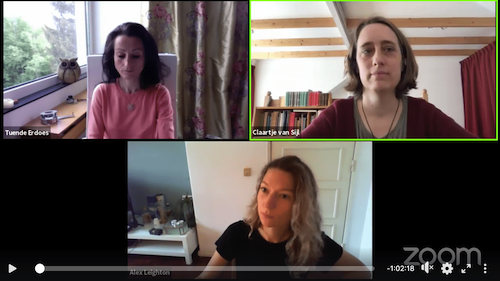
In the middle of isolation and social distancing measures I connected with two wonderful PhD candidates from Austria and Portugal, who also are a coach and a coachee or coaching client, for an open and honest conversation about the benefits and rewards of PhD coaching. We spanned Europe to talk about the human aspects of going through such a personal, transformational project as a PhD.

Here’s the recording of my live conversation with Tünde Erdös and Alex Leighton.


The humanity of excellence: crossover from coaching practice to PhD

Tuende Erdoes portrait

Tünde Erdös

Tünde Erdös is a highly experienced executive coach who is currently doing her PhD research on coaching presence and the impact it has on coaching effectiveness with Vrije Universiteit Amsterdam, Amsterdam Business Research Centre, NL in collaboration with Ashridge Centre for Coaching, UK as well as Case Western Reserve University, US. In other words, she investigates certain factors that potentially impact the effectiveness of coaching, exploring what really happens in coaching sessions.
In this interview dr. Claartje van Sijl talks with her about excellence and the personal deep motivation that drives her PhD project. We conducted the interview through several emails back and forth.

Read more

Why thriving is a better criterion for PhD success than excellence (part 1)

For her PhD project Katharina Lemmens-Krug (MSc UTwente) is studying challenges of present-day universities regarding their governance – more specifically concerning steering capacity of university leadership and the relation with centres for excellence in teaching and learning. In this interview dr. Claartje van Sijl talks with her about ways to understand excellence from the individual researcher’s perspective. The interview was conducted through several emails back and forth in November 2018. This is part 1, in which we discuss thriving as a PhD.

Read more

Why thriving is a better criterion for PhD success than excellence (part2)

For her PhD project Katharina Lemmens-Krug (MSc UTwente) is studying challenges of present-day universities regarding their governance – more specifically concerning steering capacity of university leadership and the relation with centres for excellence in teaching and learning. In this interview dr. Claartje van Sijl talks with her about ways to understand excellence from the individual researcher’s perspective. This is part 2, in which we discuss how taking the perspective of thriving contributes to improving PhD well-being.

Read more

Does the new Code for Research Integrity really makes us into Better Researchers?

The new Code for Research Integrity does not have the power it could have had, I argue. A code that only refers to research and not to acting with integrity in the broadest sense ipso facto cannot guarantee research integrity. 

(A Dutch version of this article as been published on ScienceGuide.nl)


Questions with which researchers reach out to me, as career coach, regularly have origins that go way back and actually have little to do with their current situation and the direct reason why they contact a career coach. They are reconsidering their careers and are wondering whether they should continue in academia, or at the institute where they are currently based. Before long, though, it becomes clear that something else lies underneath these questions.

Read more

PhD success and mental wellbeing in an international context (part 2)

Judith Zijlstra (MA) is doing a part-time PhD project in sociology and migration studies. She investigates international mobility in academic careers of Iranians and the ways they
translate professional experience from one context to the other.

In this interview dr. Claartje van Sijl (independent career coach for academics) discusses with her what makes an international PhD project successful (part 1) and how a cross-cultural academic career affects the mental wellbeing of the research professional (part 2). The interview was conducted through several emails back and forth in June 2018. This is part 2.
Read more