
How to take charge of your hypercritical brain
Laura sits down at her kitchen table. A welcome quiet evening between days filled with parties with family and friends over the holidays. New Year’s Eve: a traditional time of year to look back at the past year and formulate resolutions for the new year. Laura knows the power of being mindful of your successes. She is proud that she submitted her PhD thesis manuscript last year and got approval for it.
As she starts to look to the year ahead, her positive thoughts fade quickly. She resolves to find an interesting postdoc or tenure-track position, take better care of herself, collaborate with that interesting professor she met at the conference last year where she presented the final findings of her PhD project…
But then her thoughts turn to that paper that she still needs to revise. Should she have done more to finish it before the holidays? If only her supervisor had not taken so endlessly long to return feedback on her drafts. He has an easy time, being tenured, but she failed at securing a job when her PhD grant ran out. Before she realizes what is going on, Laura feels inadequate, insecure, and she is annoyed and impatient with her supervisor.
The fastest way to feel inadequate
Whether or not you are a fan of New Year’s resolutions, I bet you recognize from personal experience how easy it is to loose the supportive perspective of your inner friend. The perspective where you celebrate your victories, acknowledge your shortcomings, accept who you are, including your flaws, in an encompassing way with respect and kindness. As a good friend would see you.
Most people maintain double standards and take a more critical, judgmental perspective on themselves than they would towards a good friend. This results in harsh judgement and negative self-talk. As a researcher you are particularly vulnerable to that because your brain is trained to be hypercritical and you are required to sharpen your judgement in your daily work. This talent is not helpful when you look at your performance. Compassion towards yourself and others, to the contrary, helps you move forward and grow personally and professionally.
Stoical Compassion?
The Stoics are vehemently against compassion in the literal sense, com-passion, co-suffering, suffering together with the other. Because of their aim to eliminate all suffering —passion— through reasoned judgement, they have been widely misunderstood as being cold, rational, and unfeeling persons.
However, in fact they emphasized that the ultimately rational, wise person does experience joy and love. Not romantic love, but benevolence, a loving kindness. This kind of love is free from the passionate urges and cravings that cause suffering, but starts from acceptance of what is. The wise person is an understanding, sensitive well-wisher. In short, has compassion in the good sense.
This kind of compassionate love starts with ourselves, with self-love and self-compassion. The Stoics describe in detail how it grows from there through expanding concentric circles to family, friends, fellow citizens, until ultimately it includes all humanity.
They call this process oikeiosis: a term that is impossible to translate but indicates something like familiarization or appropriation, belonging, perceiving someone or something as one’s own. Once we have become aware of the concentric circles that encompass us and the people and the world around us, the trick is to strengthen our well-wishing from ourselves the center to the outer regions. As the second century Stoic Hierocles describes:
Once these [circles] all have been surveyed, it is the task of a well tempered man, in his proper treatment of each group, to draw the circles together somehow towards the centre, and to keep zealously transferring those from the enclosing circles into the enclosed ones…
In short, we need to exercise compassion. Not just for ourselves and our loved ones, but also for those who we feel more distant to, even to those that annoy us or that we might consider an enemy. To encourage himself in this exercise, the Roman emperor and Stoic Marcus Aurelius writes in his diary:
To feel affection for people even when they make mistakes is uniquely human. You can do it, if you simply recognize that they are human too, that they act out of ignorance, against their will…
Buddhist Compassion Practice
The Stoic notion of compassionate love is very similar to the Buddhist notion of metta, an attitude of friendliness, consideration, kindness, generosity that is the basis for compassion and joy. While Hierocles’ advice to “draw the circles together towards the centre” is rather abstract, there is a popular Buddhist meditation exercise called Metta Bhavana that helps you to strengthen your self-compassion and extend the same benevolent understanding or loving kindness to others.
Here is my visual interpretation of Hierocles the Stoic’s circles meeting Buddhist Metta Bhavana practice:
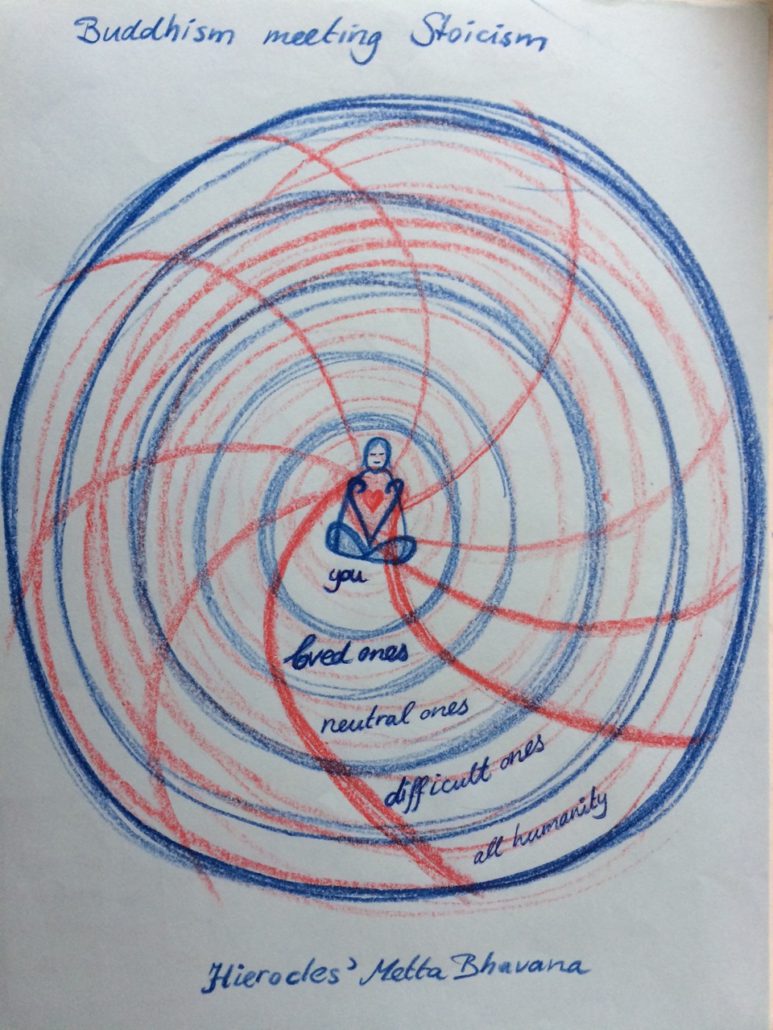
This is a simple but powerful exercise that is especially effective as a walking meditation. You can practice while walking your dog or during a lunch break walk, but basically you can do it anywhere, anytime, e.g. when you are waiting at the grocery store or during a particularly boring meeting.
You start with yourself and then proceed by thinking about an inspiring person or mentor, then a loved one, someone neutral, a person you have difficulty with and finally encompass the whole group or even all humanity.
- prepare by choosing examples of persons from each group that you can visualize in the exercise.
- turn your attention inward for a moment (closing your eyes can make that easier), take a few deep breaths.
- imagine a circle around yourself that you can fill with well-wishing love, kindness and compassion towards yourself.
- wish yourself well:
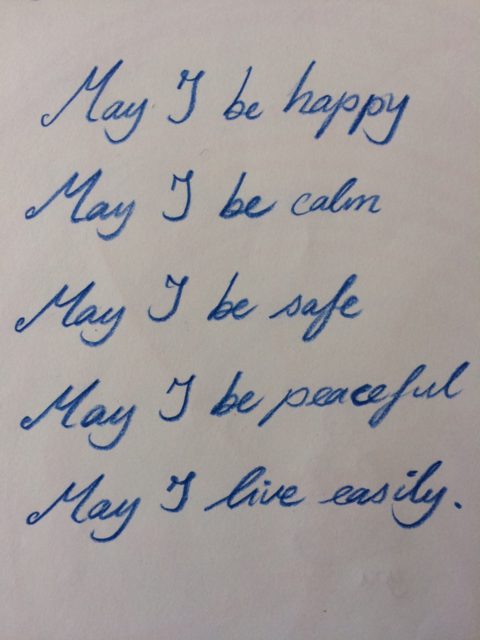
May I be happy
May I be calm
May I be safe
May I be peaceful
May I live easily
Take some time to really let these words sink in and resonate in your heart and mind. This can be easier if you speak them out loud, but you can also speak them inwardly. Notice how the area around your heart softens as you let the words resonate there. Allow the feeling of compassionate love to grow.
- imagine the circle of loving kindness to expand, encompassing someone you love. Notice how their well-being is beyond your immediate control and focus on their potential for wisdom. Use the phrases above to wish him/her well.
- repeat step 5 for someone neutral, a person you have difficulty with and finally encompass the whole group or even all humanity, respectively. I realize this is a big challenge, especially in view of political developments these days, but hey: do what you can to change the world, starting with yourself. Focus as much as you can on the positive aspects and otherwise remember Marcus Aurelius’ advice above.
- carry this attitude of compassion with you throughout your day.
Do this exercise daily for a period of two weeks and see what difference it makes to your attitudes, thoughts, and emotions during that time. I expect you to be happier and more effective.
I love to hear about your findings!

New post (How to take charge of your hypercritical brain) has been published on Van Sijl Counseling & Training https://t.co/aJgEbe1mPO
Nice overview of Stoicism on love and resilience: http://donaldrobertson.name/stoicism-love-and-resilience-slideshow