
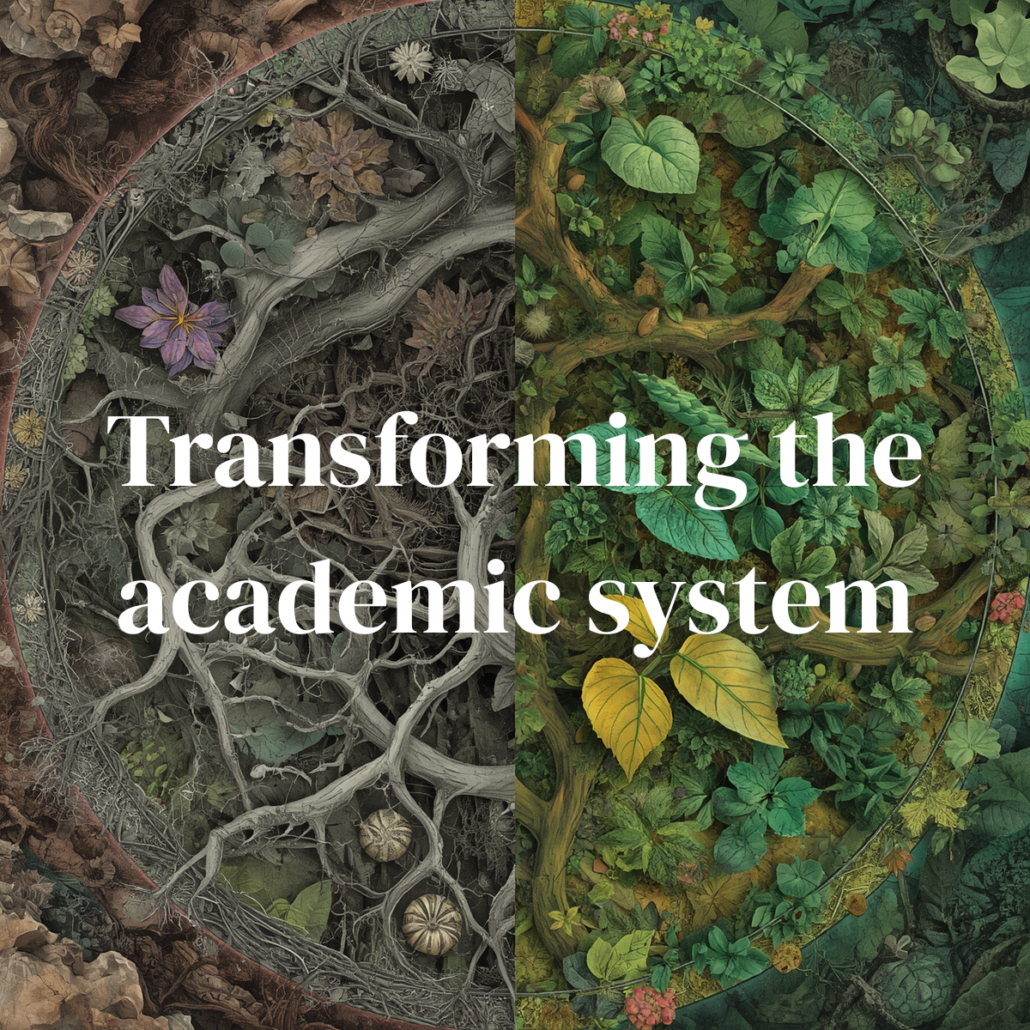
Transforming the academic system
In Trouw, Joost van Egmond reported that after six years of Recognition & Rewards (R&R), 97% of Dutch academics support the ambitions—but 73% feel no effect in their daily work. The culture hasn’t shifted. Even the programme’s own initiator, Jeroen Geurts, observes that the policy is in place, ‘the forms are printed,’ but leaders and managers struggle to make the step. This happens when you fix systems without fixing the encounters through which those systems reproduce themselves.
When Academia Hurts
The numbers on academic distress are clear: stress, anxiety and depression rates are climbing while tenured positions are vanishing under budget cuts. I’ve watched brilliant scholars burn out trying to “build resilience” while the machinery around them kept running. We teach time-management techniques alongside impossible workloads and project management next to lasting career uncertainty. We we treat symptoms while the system runs unchanged.
The question isn’t “how do we help scholars cope better?” but: what system are we sustaining, and is it worth sustaining?
Autopoiesis — The Cell That Makes Itself
Autopoiesis, biologist Francisco Varela’s term, describes how living systems constantly produce the network that creates them. A cell recreates its own boundary. Niklas Luhmann extended this to social systems: universities reproduce themselves through thousands of daily encounters that either re-enact the system’s current logic or open space for new else to emerge. Varela later developed autopoiesis into enactive cognition as model of mind and brain: we do not perceive a pre-given world; we bring forth a world through our way of being.
This reframes academic distress. It is not only exhaustion, but a clash between two autopoietic, self-reinforcing patterns:
- The academic self that seeks curiosity, rigor, and contribution
- The institutional machine that measures, extracts, and accelerates
When these clash repeatedly without repair, chronic stress emerges. This is the autopoietic gap: the old logic reproduces itself in every supervision meeting, review conversation and corridor exchange—no matter what the handbook prescribes. Culture is repaired where one academic meets another: in the pause before judgment, the reviewer who encourages instead of wounds, and the supervisor who asks “How are you?” before “What did you produce?”.
Ecosystem Repair
A micro-transformation depends on individual willpower. Someone listens to learn rather than to win or to fix. These moments matter, but they disappear when that person leaves the room. Ecosystem repair means building practices that reproduce themselves, shifting the system into a cultivation-oriented network.
The Thriving in Disruption programme that I facilitate fills this gap, complementing R&R policies. Rather than trying to eliminate disruption, this ten-week programme strengthens adaptive capacity, personally and collectively, across three pathways: personal resilience, strategic clarity, leadership maturity. The goal is not another skill but the capacity to create conditions where positive changes reproduce and spread—shifting individually from coping to asking what matters, and collectively from extraction to cultivation.
An Invitation to Nourish the Soil
Geurts calls R&R the most important dossier in Dutch academia, while noting that it still centres on individual career paths, not team dynamics. So where does real change happen?
Not at the top: policy initiatives tend to die when they hit the ground. Culture changes where the system reproduces itself — where academics meet daily in conversations, reviews, and seminars. These moments are shaped by habits we barely notice, and we can transform them from the bottom up and from the inside out.
In your next encounter, what world are you bringing forth? Thriving in Disruption builds your capacity to cultivate a sustainable academic ecosystem by practising new questions and new ways of listening. In your next encounter, academic culture actually changes: in the thousand small, everyday meetings where the new system either comes alive or quietly reverts to the status quo.


Leave a Reply
Want to join the discussion?Feel free to contribute!